

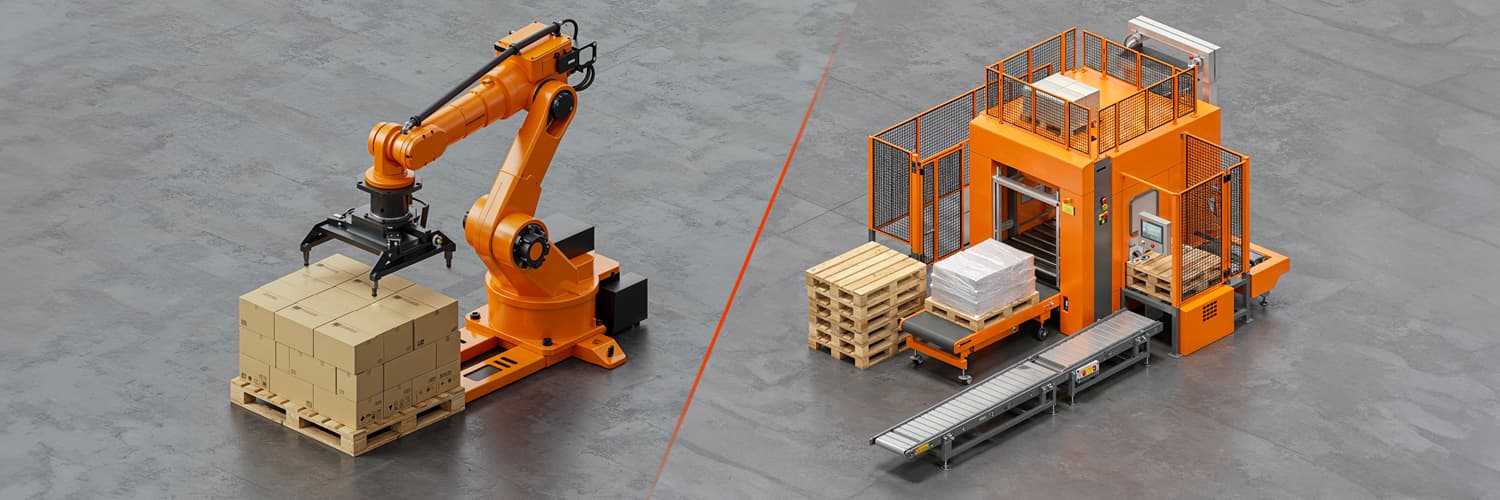

Cost-effective palletization is becoming a priority for businesses looking to improve efficiency without breaking the bank. Traditional fully automated palletizing systems with conveyors, pallet destackers, and complex infeed/outfeed mechanisms offer high throughput but come with significant costs and maintenance demands.
What is Cost-Effective Palletization?
Cost-effective palletization refers to a streamlined automation approach that uses a single palletizing robot with safety fencing but eliminates the need for expensive conveyors, pallet destackers, and motorized pallet handling systems. This setup provides a budget-friendly entry point to automation, especially for small to medium-sized operations or facilities with space limitations.
The Traditional Palletizing System: High Cost and Complexity
Fully automated palletizing lines typically involve:
· Stacked empty pallets stored in an organized manner.
· Automated pallet destacking systems that separate and feed empty pallets into the palletizer.
· Motorized conveyors to move empty pallets into the robotic cell.
· The palletizing robot stacks products on pallets.
· Motorized discharge conveyors remove full pallets from the safety zone.
While these systems are compulsory and efficient for high-speed lines palletisation, they require a large upfront investment and ongoing maintenance expenses due to the extensive conveyor and pallet handling hardware involved.
How Cost-Effective Palletization Simplifies Automation
Instead of investing in expensive conveyors and pallet destacking equipment, cost-effective palletization takes advantage of the fact that an operator is already present around the palletizing cell. This operator can simply handle the pallet feeding and discharge, which only requires a few quick interventions per hour (typically 4–5 times, depending on line speed).
· Manual feeding of empty pallets: Using a hand lift, the operator places an empty pallet inside the robot cell when needed.
· Robot palletizing: The robot efficiently stacks products on the pallet.
· Manual removal of full pallets: Once the pallet is complete, the operator uses the hand lift to remove it and replace it with a new empty pallet.
These light tasks do not involve the physical strain of carrying boxes or manually stacking them, since the robot handles the heavy and repetitive palletizing work. With this setup, the robot remains at the center of the automation process, safely enclosed by fences, while the costly accessories that typically add complexity and expense are eliminated.
Key Benefits of Cost-Effective Robotic Palletizing
1. Lower Initial Investment and Operational Costs
Eliminating conveyors and automatic pallet handling reduces capital expenditures and lowers ongoing maintenance expenses.
2. Space-Saving Design
Without long conveyor lines, the robotic cell requires less floor space—ideal for facilities with limited room or multiple production lines.
3. Faster ROI for Small to Medium Businesses
By starting with a simplified robot palletizing system, companies can automate faster and upgrade as their production grows.
Conclusion: Is Cost-Effective Palletization Right for Your Facility?
If you want to automate palletizing but your budget doesn’t allow for a full conveyor-based system, cost-effective palletization offers a practical solution. A robotic palletizer cell, combined with manual pallet feeding and discharge, can deliver improved efficiency, reduce repetitive strain injuries, and save significant capital and maintenance costs.
This simplified robotic approach lets you gain the benefits of automation, optimize your labor resources, and scale your operation when ready—all while keeping your investment lean.