

Choosing the right labelling machine is not about picking the fastest option; it’s about finding the best fit for your production needs.
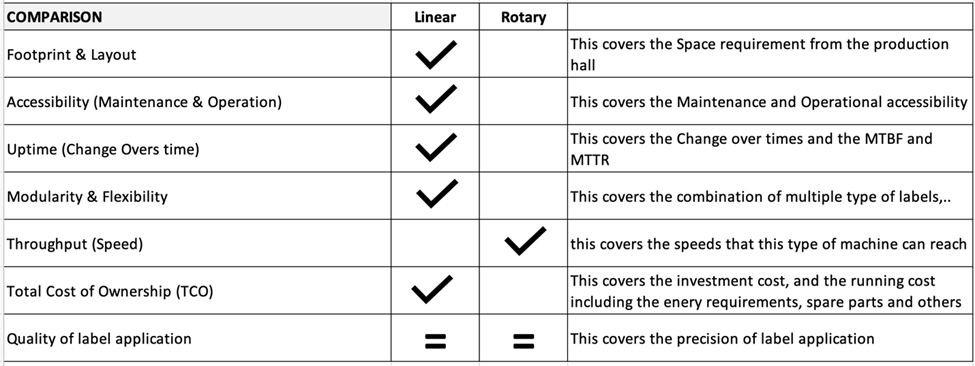
With so many options available, it’s easy to assume that rotary labelers are always superior. But how many bottles per hour is only one factor in a much larger equation that includes flexibility, maintenance, changeovers, footprint, label application capability, and total cost of ownership (TCO).
1. Footprint and line layout
Linear labelling machines are compact and integrate seamlessly into the production line’s layout. Their size simplifies line design and placement without creating bottlenecks.
By comparison, rotary machines have a larger footprint and require careful layout planning, which can limit flexibility in plant design.
2. Accessibility and maintenance
Linear labelers provide full access to all components from both sides of the machine. Maintenance and adjustments are straightforward, with no need to crawl under frames or dismantle large assemblies.
Rotary machines are mechanically denser and larger, making access more difficult and maintenance more time-consuming.
3. Changeovers: bottles and labels
There are two main types of changeovers:
- Bottle-related: linked to bottle dimensions
- Label-related: linked to label size or format
Rotary machines require multiple parts specific to each bottle that must be replaced with every changeover, such as infeed screws, star wheels, and guide rails.
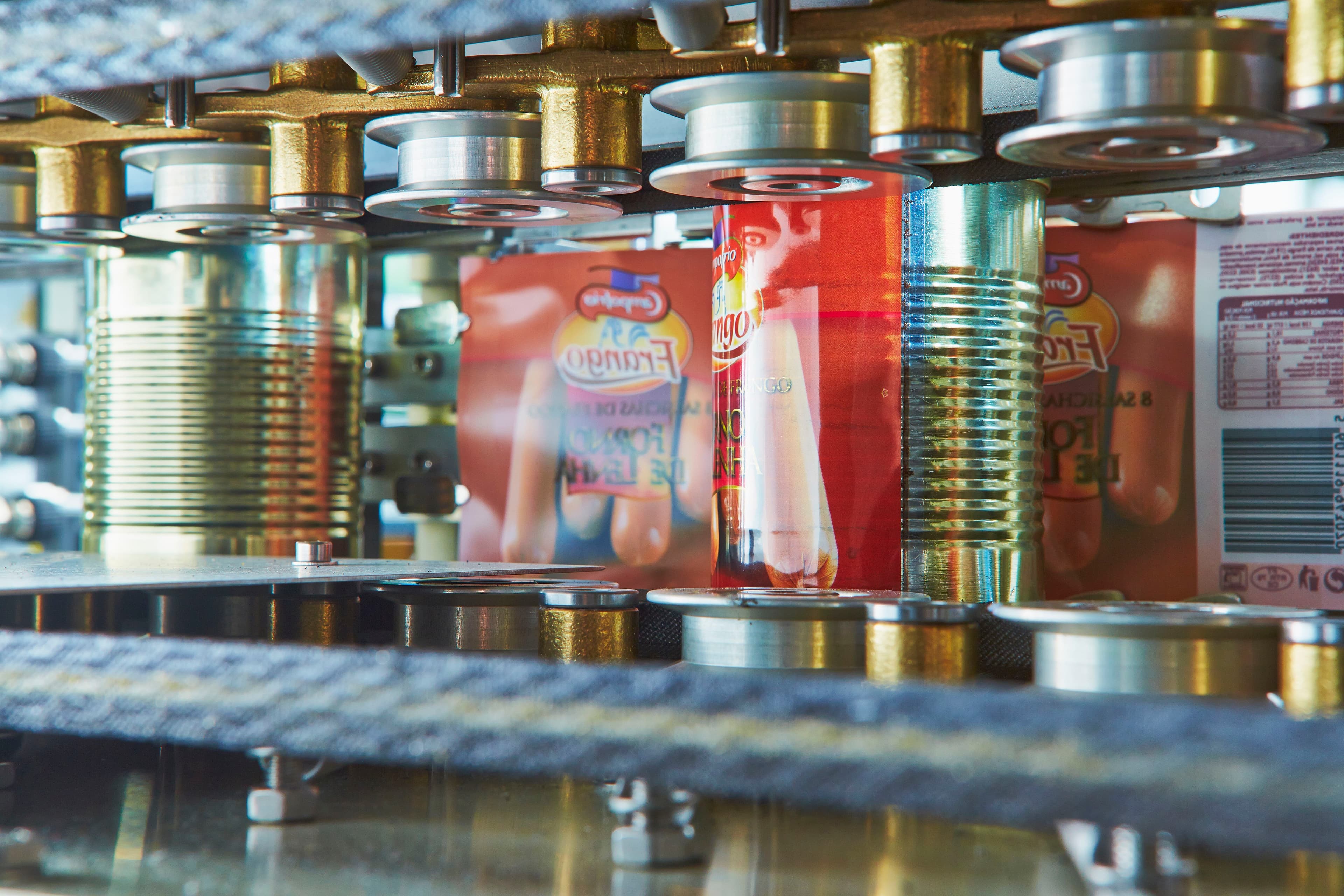
Linear machines follow a simpler approach. Bottles are metered with a side-adjustment belt mechanism, centered using a side-adjustment chain mechanism, stabilized by an upper belt, and labelled from the front, back, or sides as needed. Changeovers are quick with near-zero parts replaced.
4. Modularity & Flexibility
The linear machine is, by design, modular, like a puzzle, and configured to meet the requirements of each application.
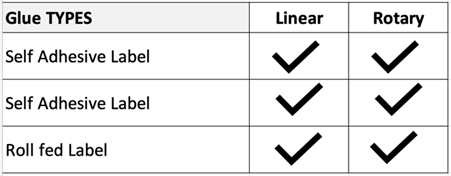
For example, you can combine a cold-glue label application with a self-adhesive label application to achieve the final result you need.
Linear labelling machines often make complex label applications simpler and more practical to implement. They can handle:
- Front, back, neck, and tamper-evident labels
- Multiple labels on a single bottle
- Asymmetrical or complex container shapes
- Complex formats are used in home and personal care, food and beverage and chemical packaging industries.
More and more rotary machines are designed with modular options, allowing you to activate or deactivate specific modules for specific containers.
More modules for a linear machine might increase the length of the machine; more modules for rotary machines would increase the diameter of the machine, or require an interchangeable labelling unit that needs to be stored around the machines.
5. Speed
Speed is often the first metric considered when comparing labelling machines, but it’s also one of the most misunderstood.
Rotary labelling machines are designed for very high nominal speeds. When running a single SKU for long production runs, rotary systems become highly efficient.
Linear labelling machines typically operate at lower speeds, but this depends on the application. Some are limited to 24.000 CPH, and some, like a hot melt paper label applicator on cans, could reach 60.000 BPH
7. Total Cost of Ownership (TCO)
Linear machines have far fewer moving parts than rotary machines. Fewer parts result in:
- Lower inertia
- Reduced energy consumption
- Fewer spare parts requirements
- Simpler maintenance
Rotary machines consume more energy and require more intensive maintenance, increasing operating costs and overall TCO.
8. Labels and Glue Types
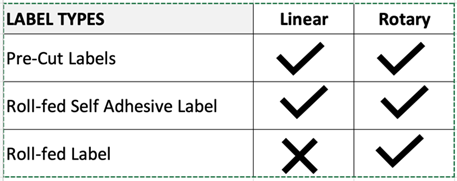
Roll-fed labels, which come on rolls and need to be cut and applied, are uncommon on linear labelers. This is mainly an application for the plastic label, glued with hot melt and applied in the water and CSD industries.
Takeaway
There is no one-size-fits-all solution. The best labelling machine is the one that aligns with your production realities, SKU diversity, and operational priorities.
Linear type labelling machines win when you have multiple SKUs, varied label applications, and frequent changeovers are part of daily operations. Linear labelling machines offer a compelling balance of flexibility, efficiency, TCO, and simplicity that many rotary systems struggle to match.
Rotary type labelling machines remain a strong solution when you run a single SKU with Production volumes that are very high and stable, and Changeovers are rare, and long runs are the norm
For single-product, high-speed lines, rotary labelers may still be the right choice.