

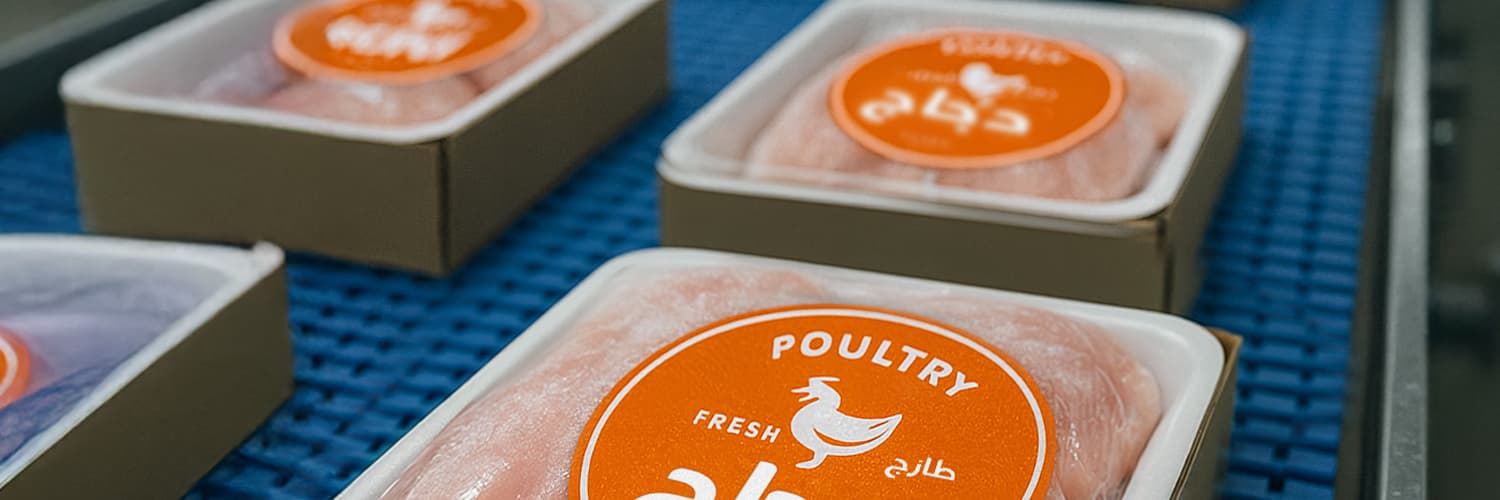

The Kingdom of Saudi Arabia’s meat and poultry industry is at a pivotal stage. With rising consumer demand, an increasingly competitive market, and Vision 2030’s push for operational excellence, factories are under immense pressure to produce more, faster, and at consistent quality levels. For many producers, the answer lies in automation — not as a luxury, but as a necessity for sustainable growth.
Scaling Production Through Smart Automation
For factories aiming to increase production output, automation offers unmatched potential. Traditional setups often rely heavily on manual labor for critical yet repetitive tasks such as palletizing, crate handling, and tray filling. While this may suffice for small-scale operations, it quickly becomes a bottleneck when production needs to scale.
A single robotic palletizing solution can manage multiple production lines, dramatically improving throughput. For example, a poultry factory with 12 production lines can deploy just three robotic palletizing systems to handle the workload — effectively consolidating processes, eliminating inefficiencies, and boosting productivity.
Maximizing Efficiency Across Multiple Lines
The strategic advantage here is integration. One advanced robotic system can be configured to serve several production lines simultaneously. This means fewer pieces of equipment, better space utilization, and more streamlined workflows. Factories that adopt this approach can achieve:
· Higher throughput without needing to add extra shifts or floor space.
· Shorter changeover times between batches and product types.
· Optimized labor allocation, focusing human effort on tasks that require skill and oversight rather than repetitive, physically demanding work.
Real-Time Data for Smarter Production Decisions
Automation in poultry processing is not just about moving crates and pallets — it’s about connecting the entire production floor to a smart, data-driven system. When factories adopt automation, they gain access to real-time production data, enabling:
· Instant performance tracking across all lines.
· Predictive maintenance to prevent breakdowns and reduce downtime.
· Better demand forecasting and inventory management.
This level of connectivity empowers managers to make informed decisions, respond quickly to changes, and keep production running smoothly.
Protecting Workers from Harsh Environments
In many meat and poultry factories in KSA, operators work long hours in cold or freezing conditions, performing physically demanding tasks like filling trays of chicken, loading crates, stacking pallets, and moving them into frozen storage. This environment can lead to fatigue, health risks, and high employee turnover.
By introducing robotic palletizing systems, factories can:
· Reduce the number of workers exposed to extreme cold.
· Improve workplace safety and reduce injury risks.
· Redeploy operators to less physically demanding, higher-value roles.
A Solid Return on Investment (ROI)
Some factory owners hesitate to invest in automation due to the perceived upfront cost. However, when factoring in reduced labor costs, increased throughput, minimized downtime, and improved product handling quality, the payback period is often shorter than expected. For large facilities — such as those with 12 production lines — installing 3 robotic palletization systems can transform productivity while delivering a tangible ROI within a few years.
Staying competitive means producing more with greater efficiency, higher consistency, and better working conditions. Robotic automation not only solves the production challenges of today but also positions factories to meet the market demands of tomorrow.
For factories with multiple production lines, a strategically deployed robotic palletizing solution can be the key to unlocking higher output, safer operations, and stronger profitability — all while aligning with the Kingdom’s vision for industrial innovation.