

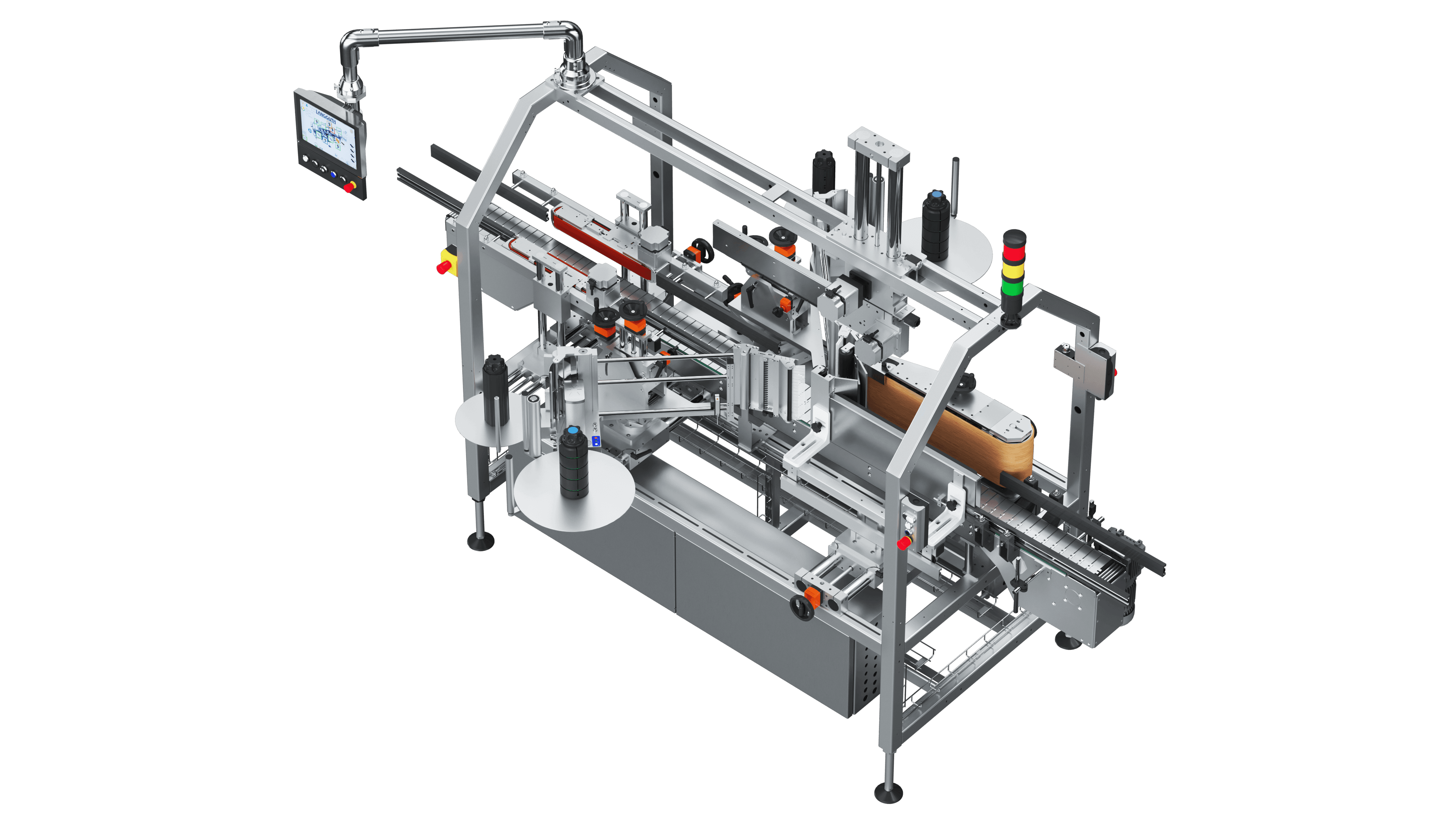

Is higher speed the only factor to consider when choosing a labelling machine? For many beverage manufacturers, the answer is changing.
Rotary labelers were the go-to solution for high-speed beverage lines. With output rates of 36,000–48,000 bottles per hour and a robust mechanical design, rotary machines are a strong choice for stable, high-volume production.
At the same time, production environments are evolving. Manufacturers are managing a growing number of SKUs, more frequent format changes, and increasing demands for flexibility. In these conditions, many producers are discovering the value of linear labelling machines.
What’s Driving the Shift
Rotary machines often rely on numerous change parts and spare components, require longer maintenance routines, generate waste during changeovers, and involve complex setups when handling multiple SKUs. At high speeds, these factors can quickly add up. Each format change may result in extended downtime, higher labor involvement, and operational complexity.
In contrast, linear labelling machines often make complex labelling applications simpler and more practical to implement. Achieving the same level of label complexity on a rotary system typically requires a larger, more intricate machine, driving up footprint, cost, and operational overhead.
Modern linear labelers are far more capable than many assume. Today, they can handle:
- Front, back, neck, and tamper-evident labels
- Multiple labels on a single bottle
- Complex formats, including those used in personal care and shampoo packaging
Thanks to their straight-line design and modular architecture, even advanced labelling configurations can be implemented efficiently and within a compact footprint.
Linear labelling machines are valued for their simplicity, modularity, and operational flexibility, offering:
- Shorter and simpler changeovers
- Easier access for operation and maintenance
- Greater adaptability for multi-SKU production
- More stable day-to-day performance
What This Means for Manufacturers
Productivity today is defined by more than peak speed alone. Uptime, changeover efficiency, ease of operation, and flexibility all play a critical role in overall line performance.
Manufacturers that integrate linear labelling machines benefit from:
- Greater flexibility across multiple SKUs
- Faster and more predictable changeovers
- Improved accessibility for operators and maintenance teams
- Reduced operational risk in dynamic production environments
Rotary labelers remain a strong solution for single-SKU, high-volume production. Linear labelling machines, on the other hand, offer clear advantages where variety, adaptability, and operational simplicity are priorities.
The key is to assess the real demands of your production floor and how much flexibility your operation truly needs to choose the solution that best aligns with them.